

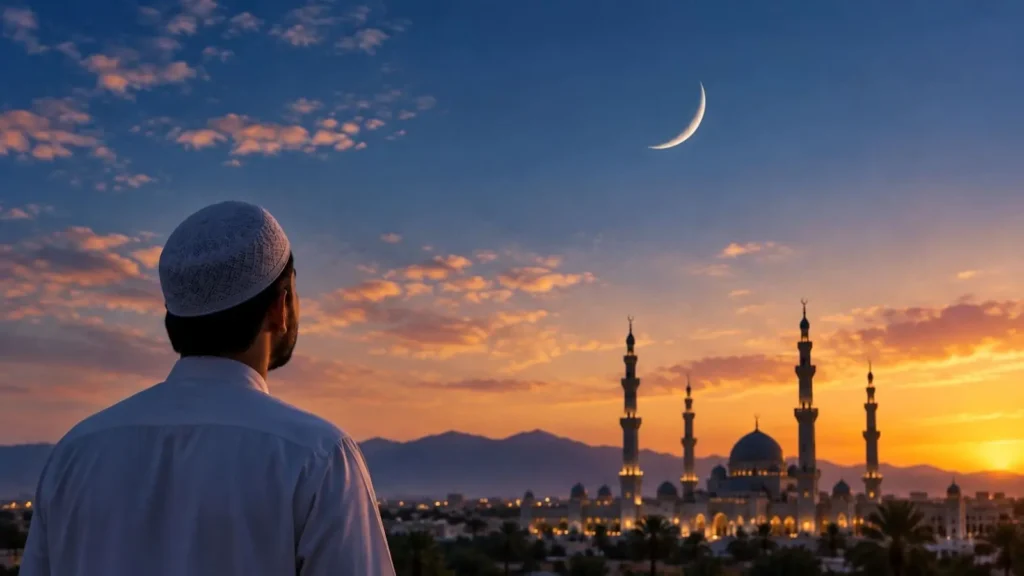
Every year, the same question circulates among Muslim communities worldwide as Ramadan or Eid approaches: has the moon been sighted yet? Moon sighting in Islam is not a minor detail of the calendar; it is the method that determines when entire months begin and end, shaping fasting, Hajj, Umrah, and major religious observances around the world.
The Basis of the Islamic Lunar Calendar
Unlike the Gregorian calendar, which follows the sun, the Islamic lunar calendar is based entirely on the moon’s cycle. Each month begins with the sighting of the new crescent moon, known as the hilal, rather than a fixed date calculated in advance. This is why Islamic months run roughly 29 or 30 days and shift about ten days earlier each year relative to the solar calendar.
How the Sighting Process Works
Traditionally, observers physically look for the crescent moon just after sunset near the end of a lunar month. If it is sighted and confirmed by reliable witnesses, the new month begins the following day. If it is not sighted, whether due to weather, position, or timing, the current month is extended by a day, and the process repeats. This method traces directly back to practices established during the time of the Prophet Muhammad, peace be upon him.
The Role of Moon Sighting Committees
Most countries with significant Muslim populations have an official body responsible for confirming sightings, often made up of religious scholars working alongside astronomers. In Saudi Arabia, this responsibility falls to the Supreme Court, which announces the start of Ramadan, Shawwal, and Dhul Hijjah based on verified testimony. Other countries, including Pakistan, Indonesia, and Malaysia, maintain their own committees, which is part of why announcements do not always align across borders on the same night.
Why Sighting Sometimes Varies by Region
- Geographic visibility: The moon becomes visible at different times depending on longitude, so a sighting confirmed in one country may not yet be possible in another.
- Local versus global methods: Some countries rely on local sightings within their own borders, while others accept sightings confirmed anywhere in the Muslim world.
- Weather conditions: Cloud cover or haze can delay a confirmed sighting even when the moon is technically present in the sky.
This is the main reason Ramadan or Eid sometimes begins on different days in different countries, a source of regular discussion within Muslim communities, though scholars generally agree that either approach is religiously valid.
Efforts Toward a Unified Approach
In recent years, astronomical calculations have made it possible to predict moon visibility with real precision, and some organizations now combine calculations with traditional sighting to reduce discrepancies between countries. Full global unification has not happened yet, largely due to differing scholarly opinions on whether calculation alone should replace physical sighting, but the gap between countries has narrowed considerably compared to a few decades ago.
What This Means for Pilgrims and Travelers
For anyone planning Umrah or Hajj, the lunar calendar has real practical weight. Ramadan Umrah dates, Hajj timing, and even flight and hotel pricing shift each year based on when the relevant crescent is sighted, which is why travel plans built around the Islamic calendar benefit from some flexibility in the days immediately before departure.
Preparing for a Calendar That Shifts Each Year
- Build in a buffer around your travel dates, flights, and hotel bookings tied too tightly to an assumed date can be disrupted if the sighting is confirmed a day earlier or later than expected.
- Follow announcements from an official source, national moon sighting committees, or the Saudi Supreme Court are more reliable than unofficial predictions circulating online.
- Ask your travel provider about flexible rebooking, a good Umrah or Hajj package accounts for this uncertainty rather than penalizing travelers for it.
Dawn Travels tracks moon sighting announcements closely each season and helps pilgrims plan Umrah and Ramadan travel dates with that flexibility already built in, so last-minute calendar shifts do not disrupt a trip that has been planned for months.